
9 Best Email Deliverability Consultants for Gmail and Yahoo Sender-Rule Recovery

You passed every authentication check, yet Gmail still tosses revenue-critical emails into Spam while Yahoo remains opaque. Send about 5,000 messages in a single day and Gmail stamps your primary domain as “bulk.”
Since November 2025, it even rejects any message that misses a single rule, especially when user-reported spam creeps above 0.3 percent. Yahoo’s standard feels similar: it flags “significant volume” rather than a fixed number.
Finding the best email deliverability consultants is now mission-critical. We combed public case studies, tooling, and mailbox-provider rulebooks to rank nine specialists so you can choose the right partner and win back the inbox.
The Best Email Deliverability Consultants at a Glance
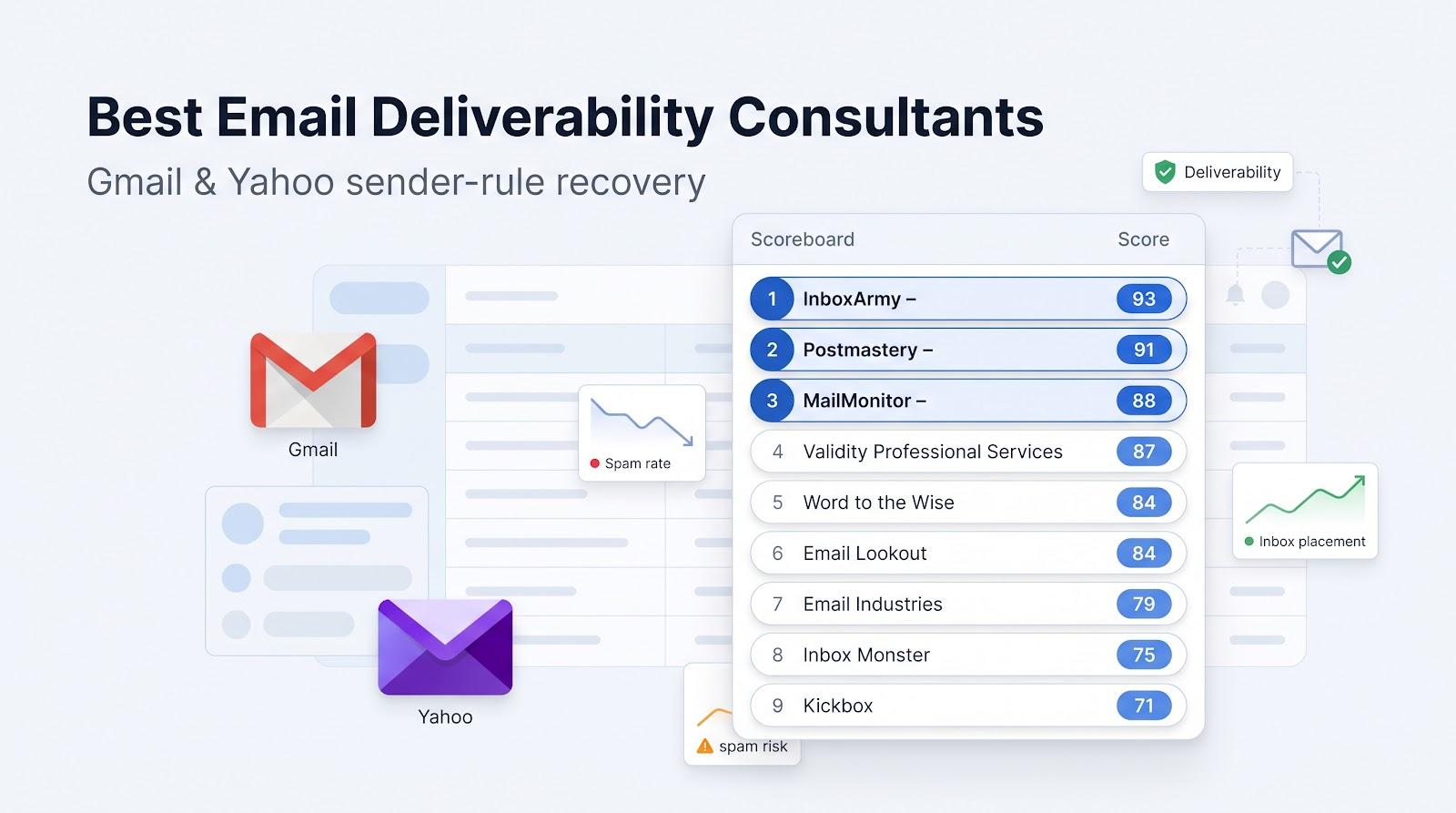
Choosing a consultant is simpler when every key fact appears on one line. The scoreboard below compiles public evidence of recoveries, technical depth, rule fluency, monitoring skill, enterprise fit, and pricing clarity.
|
Rank |
Consultant |
Best for |
Engagement type |
Monitoring |
Hands-on |
Score |
Pricing visibility |
|
1 |
InboxArmy |
Full-service recovery & execution |
Agency retainer |
Yes |
Yes |
93 |
Quote-only |
|
2 |
Postmastery |
High-volume MTA & infrastructure |
Project or managed |
Yes |
Yes |
91 |
Quote-only |
|
3 |
MailMonitor |
Seed testing + remediation |
Platform + services |
Yes |
Yes |
88 |
Bundle |
|
4 |
Validity Engage |
Enterprise data stack |
Platform + services |
Yes |
Partial |
87 |
Bundle |
|
5 |
Word to the Wise |
Forensic diagnosis & training |
Advisory project |
Optional |
No |
84 |
Quote-only |
|
6 |
Email Lookout |
Direct senior consultant |
Audit + monitoring |
Yes |
Limited |
84 |
Published rates |
|
7 |
Email Industries |
Specialist boutique team |
Fractional support |
Yes |
Yes |
79 |
Quote-only |
|
8 |
Inbox Monster |
Data-led expert services |
Platform + services |
Yes |
Partial |
75 |
Bundle |
|
9 |
Kickbox |
List-quality-led recovery |
Audit + hygiene |
Optional |
Limited |
71 |
Bundle |
We ranked these nine because each cleared six strict gates: permission-based focus, Gmail and Yahoo rule fluency, no inbox guarantees, hands-on remediation, evidence in the public domain, and independence from artificial warm-up tactics.
A 93 reflects verified breadth; it doesn’t mean InboxArmy is the right choice if you only need a fast DMARC tune-up. Use the table as a compass. Next, we’ll dive into each provider so you can match your pain point to the team that can fix it.
Gmail’s Bulk-Sender Threshold and Permanent Status
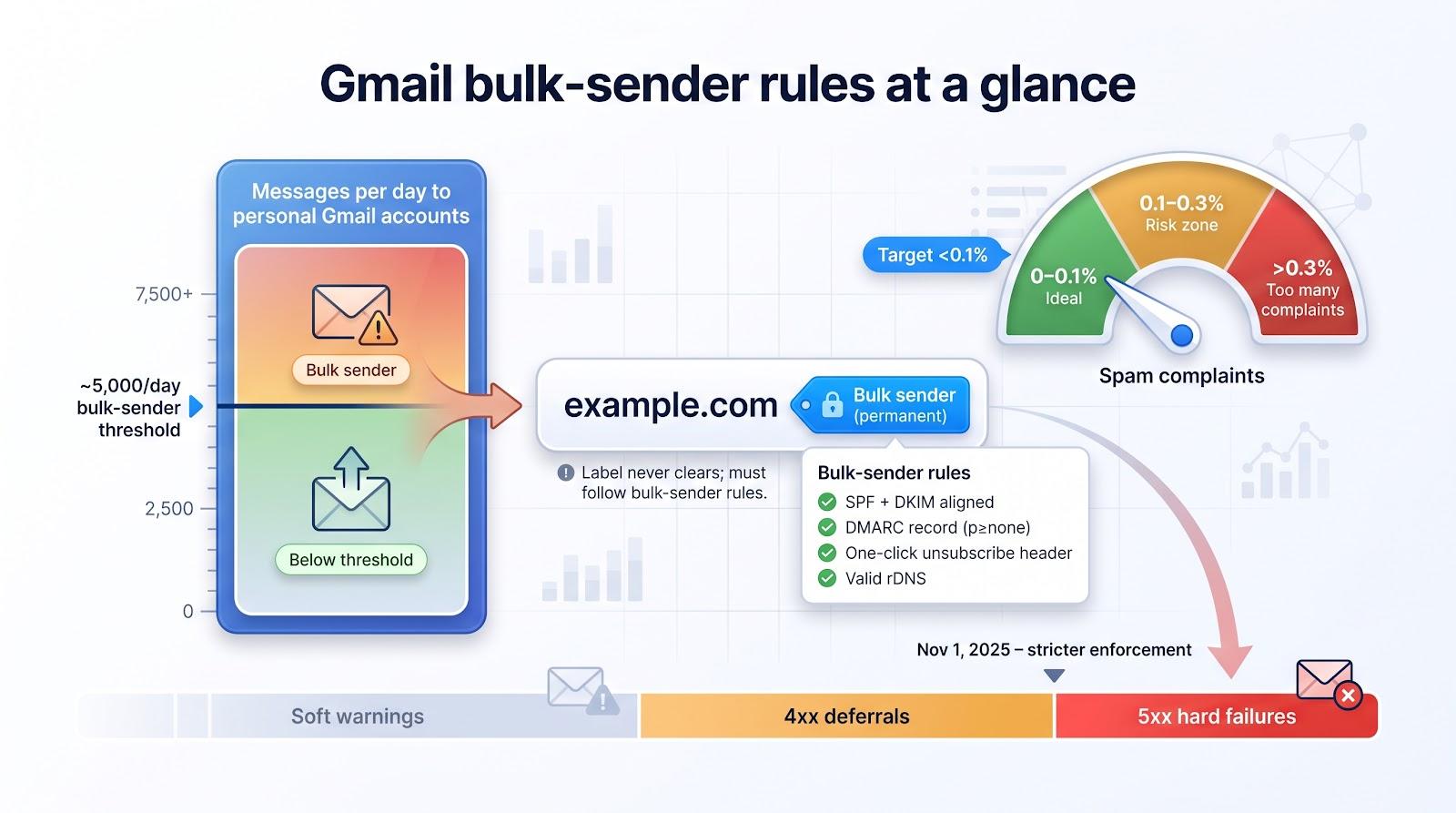
Gmail draws its bulk-sender line at roughly 5,000 messages a day to personal Gmail accounts. Cross that line even once, and the entire primary domain is tagged as a bulk sender. Subdomains offer no shelter because Gmail rolls up volume at the parent-domain level Gmail sender guidelines.
The label never clears. From that moment, you must follow bulk-sender rules: SPF and DKIM that pass and align, a header-level one-click unsubscribe, a DMARC record (at least p=none), valid rDNS, and a user-reported spam rate below 0.3 percent. Aim for less than 0.1 percent to keep headroom.
On November 1, 2025, Gmail moved from soft warnings to outright rejections. Non-compliant messages first receive 4xx deferrals, then hard-fail with 5xx codes. Revenue stalls, queues build, and domain reputation sinks.
Recovery demands tight volume control, perfect authentication, and steady complaint management. A subject-line tweak will not fix it.
Every consultant in our top nine treats Gmail’s threshold and enforcement timeline as the first risk checkpoint, before reviewing content, cadence, or creative.
Yahoo’s rules are similar but not identical
Yahoo follows the same spirit as Gmail: authenticate, keep complaints low, honor opt-outs. Unlike Gmail, it never publishes a numeric bulk threshold. The sender team flags significant volume in real time, so if you already trip Gmail’s 5,000-message bar, expect Yahoo scrutiny as well (Yahoo Sender Hub best-practices page).
Key requirements mirror Gmail’s. SPF, DKIM, and DMARC must align with the visible From domain. Promotional mail needs both a header-based and a visible-body unsubscribe to be processed within two days.
Yahoo caps the complaint rate at 0.3 percent, and its Complaint Feedback Loop reports give you early warning before a block. Policies cover Yahoo and AOL domains together, so one mistake hurts both brands.
Watch one operational wrinkle: the Complaint Feedback Loop enrolls by DKIM domain.
If you change your signing domain mid-recovery, you must re-enroll, or you will lose the “This is spam” alerts essential for reputation work (Yahoo Sender Hub feedback-loop page). Experienced consultants build that detail into every remediation roadmap.
Compliance does not guarantee inbox placement
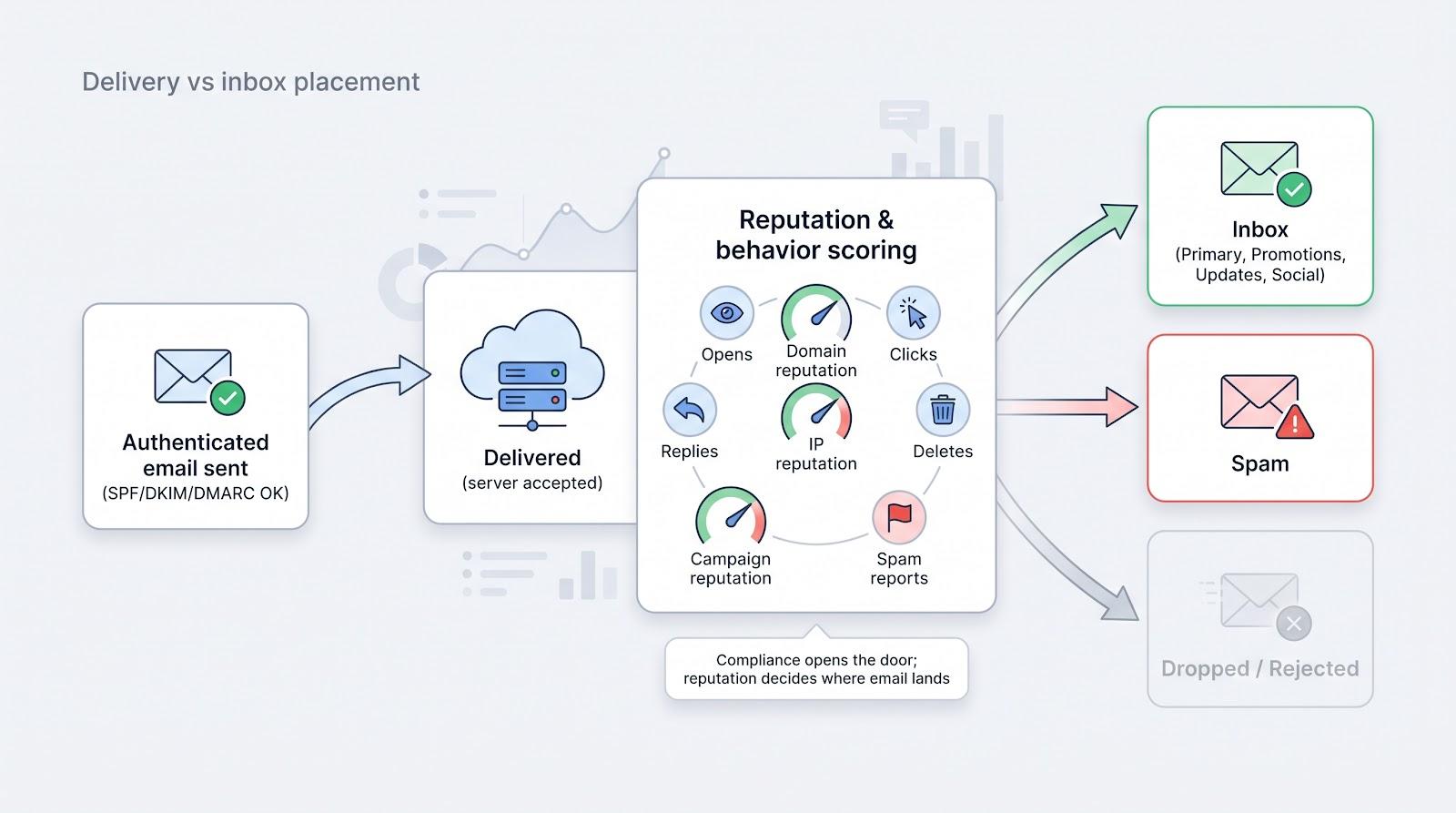
Passing every technical check only gets your email through the gate. A fully authenticated, RFC-clean message can still land in Spam or disappear because mailbox providers score behavior, not just mechanics.
They analyze recipient actions such as opens, clicks, deletions, and spam reports, then feed those signals into live reputation models for your domain, IP, and even individual campaigns.
In short, “delivered” means the server accepted the message. The real prize is the inbox; Promotions, Updates, and Social tabs still count as inbox categories, while Spam does not. Hard rejections or silent drops hurt most because you never see the failure.
Smart consultants monitor reputation as closely as compliance. They line up Gmail Postmaster spam-rate curves with engagement trends, review Yahoo Complaint Feedback Loop data, and use seed or panel testing to confirm where accepted mail actually lands. Compliance opens the door; reputation decides whether the message is invited inside.
What sender-rule recovery really means
Recovery is a program, not a one-time DNS tweak. A clear roadmap looks like this:
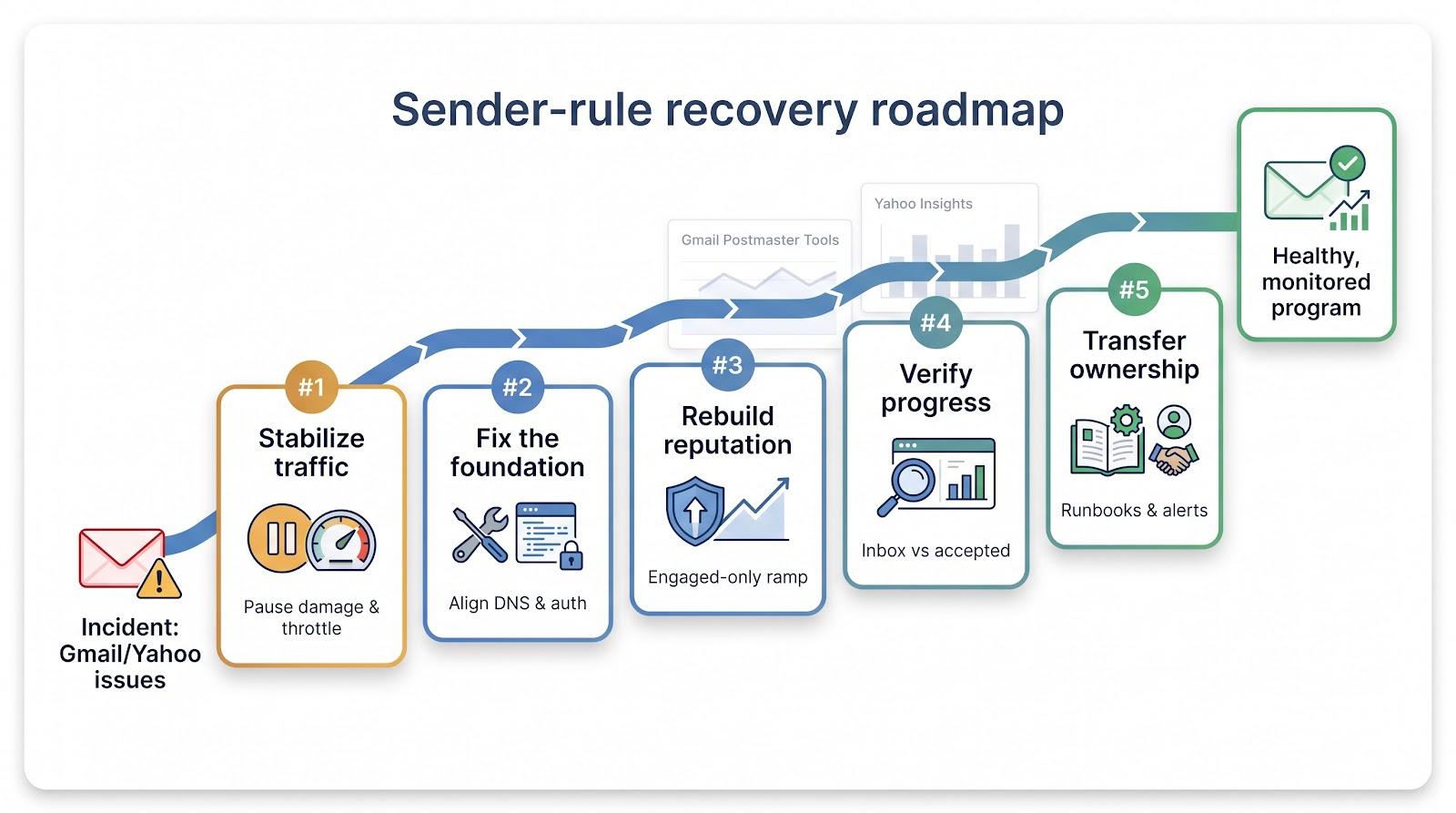
- Stabilize traffic. Pause or throttle the sends causing damage, and focus on your most-engaged subscribers until rejection storms clear.
- Fix the foundation. Align SPF, DKIM, and DMARC; correct rDNS and HELO values; classify bounces accurately; and verify one-click unsubscribe headers.
- Rebuild reputation. Send only to active recipients, ramp volume gradually, and monitor Gmail, Yahoo, and Microsoft dashboards every day.
- Verify progress. Compare accepted-mail counts with real inbox placement, adjusting cadence or segmentation when complaints or traps spike.
- Transfer ownership. Deliver runbooks, dashboards, and alert thresholds so your team can detect issues before Finance does.
Anything less is a quick bandage, useful for a moment but no cure for long-term inbox health.
How we ranked the consultants
Data beats guesswork, so we built a scoring model anyone can audit.
Step 1. Clear six hard gates. A firm had to:
- Focus on permission-based email only.
- Master Gmail and Yahoo sender rules.
- Refuse inbox guarantees.
- Offer hands-on remediation (not reports alone).
- Avoid artificial warm-up or look-alike domains.
- Publish at least one verifiable result.
Step 2. Score seven factors that drive real recovery.
|
Factor |
Weight |
|---|---|
|
Proven outcomes |
25 percent |
|
Technical depth |
20 percent |
|
Rule-compliance fluency |
15 percent |
|
Live-data monitoring |
15 percent |
|
Enterprise fit |
10 percent |
|
Independence |
5 percent |
|
Commercial transparency |
10 percent |
Each provider earned a raw 1-5 score per factor, multiplied by the weight for a 100-point total.
Step 3. Add an evidence-confidence label.
- High: Named case studies or independent reviews.
- Medium: Strong first-party claims but limited external proof.
- Low: Marketing copy only.
Scores refresh whenever new, verifiable evidence, such as a fresh Yahoo recovery, appears. The result is a living, transparent scoreboard you can inspect line by line before trusting anyone with your inbox revenue.
1. InboxArmy – Best overall for full-service deliverability recovery
Need a partner that fixes reputation and ships the next campaign? Start here. For teams comparing the best email deliverability consultants, InboxArmy tops our list because its evidence spans technical remediation, list hygiene, warm-up, and end-to-end execution across 40-plus ESPs.
Founded in 2016 and based in Grapevine, Texas, the full-service email marketing agency focuses exclusively on email and SMS for more than 5,000 brands across 25 industries.
Senior practitioners lead every project, with no junior hand-offs. In a recent Zinch case study, InboxArmy cut bounce rate from 10 percent to 0.55 percent and shifted domain reputation from bad to high, proving that results stick when one team owns implementation.
Engagement begins with onboarding and kickoff during the first four weeks, then moves to weekly production and check-ins from week five onward. Public pricing is limited; deliverability audits start around $2K-$5K. The agency’s own terms are no hidden fees and no long-term lock-ins.
Why pick them
- Hands-on execution: DNS changes, suppression rules, segmentation, campaigns.
- Broad scope: audits cover SPF, DKIM, DMARC, reputation, blacklists, list hygiene, engagement, and inbox placement.
- Continuity: a dedicated team diagnoses, fixes, and monitors the account.
Watch for
- The full package may feel large if you only need a narrow audit.
- Published managed-service pricing would speed procurement reviews.
Ideal for mid-market or enterprise senders running multiple revenue-critical streams that must stay out of Spam while campaigns keep flying.
2. Postmastery – Best for high-volume MTA and infrastructure complexity
When the deliverability bottleneck lives inside your SMTP engine, Postmastery is the specialist to call.
Headquartered in the Netherlands, the team audits, tunes, and even runs MTAs such as PowerMTA, KumoMTA, Postfix, and Halon. A proprietary monitoring console surfaces deferrals, block-list hits, and authentication drift in near real time.
Depth is their edge. Engineers comb through logs, trace handshake failures, rebuild DKIM keys, and design subdomain strategies that keep marketing and transactional streams from colliding. The firm’s public material centres on infrastructure recoveries after large-scale migrations, including a published Omeda migration story; ask for a named reference in your volume band during diligence.
Engagements come in two forms: project-based remediation or an outsourced managed deliverability service that watches traffic daily. Pricing is custom, and time-zone differences can slow same-day U.S. stand-ups, but clients say the extra effort pays off for genuine MTA expertise.
Choose Postmastery when volume and complexity sit in your ops stack, not your creative brief.
3. MailMonitor – Best for seed testing plus hands-on remediation
Guessing where “delivered” mail actually lands wastes time. MailMonitor turns placement into hard numbers, then helps you act.
The platform’s global seed network reports Primary, Promotions, Updates, or Spam verdicts in a single dashboard. Consultants layer those readings with bounce codes, complaint trends, and block-list checks to pinpoint why Gmail or Yahoo rejected you. MailMonitor’s published Fusion HCS case study reports 90 percent more inbox placements across a one-million-contact list.
Unlike pure monitoring tools, MailMonitor’s services team edits DNS, rewrites headers, and guides list hygiene so each send benefits from fresh data. A typical engagement starts with a free audit call, moves to a scoped remediation project, and ends with ongoing placement and reputation monitoring.
Watch for the bundle. Because software and consulting are inseparable, you must license the platform even if you only need a one-off fix. For brands that want objective placement proof and expert hands on the controls, the package often repays its cost the first time a revenue campaign reaches the inbox.
4. Validity Engage – Best enterprise platform and data stack
Large programs run on data. When deliverability sits at the crossroads of placement, verification, and creative QA, Validity Engage brings the full toolkit with expert support attached.
Validity now sells these as one platform, Validity Engage, which folds in inbox placement and reputation data, BriteVerify contact verification, and Litmus email testing, with expert support and a customer success manager attached to enterprise contracts. Consultants connect the tools and translate findings into roadmaps that marketing, legal, and engineering teams can follow.
Global retailers and fintech brands use this suite to unite dozens of regional ESP instances under one scorecard. Consultants run baseline audits, build dashboards, retrain suppression rules, and teach internal analysts to read provider signals.
Live monitoring surfaces Gmail spam-rate spikes, Yahoo complaint trends, and Microsoft 550 5.7.515 errors so teams can react before revenue dips.
Trade-offs
- You pay for software and services, so budgets add up fast.
- Smaller teams may find the platform heavy for limited needs.
- Recommendations often center on Validity tools, which independence purists may question.
Pick Validity when you need integrated monitoring, verification, creative testing, and strategy across thousands of campaigns a month without stitching multiple vendors together yourself.
5. Word to the Wise – Best for forensic diagnosis and team education
Certain deliverability issues hide so deep they need a digital detective rather than an agency army. Word to the Wise fills that role.
Founded by industry veterans Laura Atkins and Steve Atkins in 2001, the consultancy specialises in untangling block-lists, malformed MTAs, and policy pitfalls that stump most service desks. Clients call when standard fixes fail, such as a persistent Gmail spam problem despite clean authentication or an unexplained Yahoo complaint spike.
Engagement starts with a forensic audit: raw SMTP logs, Gmail Postmaster data, Yahoo Feedback Loop files, and block-list responses are dissected until the root cause appears.
The team then trains marketers, developers, and sysadmins to prevent a relapse. Deliverables include tailored playbooks, classes, and one-on-one mentoring with the partners themselves.
Because Word to the Wise centres on diagnosis and guidance, you’ll need internal or external resources to implement fixes. Pricing is custom and capacity limited, so book early if you face a critical incident. If knowledge transfer matters as much as getting back to the inbox, this partner leaves your team smarter than it found them.
6. Email Lookout – Best for direct access to a senior independent consultant
Need a single expert instead of an agency pod? Email Lookout keeps things simple.
Founder Tom Sather spent 12 years at Return Path (later Validity), where he led deliverability consulting and worked directly with Gmail, Yahoo, AOL, and Outlook on reputation and block-list escalations. Clients value speaking with the decision-maker on every call.
The engagement is straightforward:
- Two-week audit surfaces authentication gaps, complaint hotspots, and segmentation risks.
- You receive an action list, a monitoring plan, and optional ongoing monitoring, with monthly reports, where Tom reviews Gmail, Yahoo, and Microsoft telemetry before issues snowball.
Trade-offs
- Capacity is limited to a handful of high-touch accounts.
- Rates are published ($200 an hour with a four-hour minimum; audit packages from $2,000), but public case studies are fewer than at larger firms, so request references during diligence.
If you have staff to implement fixes and need senior guidance fast, Email Lookout delivers clarity without agency overhead.
7. Email Industries – Best specialist boutique or fractional team
Some brands need more skill than a solo adviser can offer but less red tape than a global agency. Email Industries fills that middle ground.
A compact team of deliverability engineers rotates across audits, remediation sprints, and fractional head-of-deliverability roles. The model suits SaaS and fast-growing ecommerce brands that have outpaced a single hire yet don’t require a full-time director.
Engagement begins with a 360-degree audit covering authentication, infrastructure, list sources, engagement decay, and complaint loops. From there, the team drafts a phased recovery plan, fixes DNS and ESP settings, and coaches marketing staff on segmentation, ramp, and complaint suppression. When volume spikes loom, clients re-engage the team for warm-up oversight so holiday sends land clean.
Independent reviews remain limited, so ask for a redacted Gmail or Yahoo recovery during diligence. Pricing is custom; ask whether the fractional model can be scaled up or down month to month.
Choose Email Industries when you want a fractional, plug-and-play deliverability crew that grows with campaign velocity without full agency overhead.
8. Inbox Monster – Best data-led expert services
Inbox Monster began as a monitoring platform. Customers soon asked, “Can you fix what the dashboard finds?” The team responded by creating an expert-services arm that pairs deep telemetry with hands-on remediation.
The software scans Gmail, Yahoo, Microsoft, and dozens of other providers through seed accounts. It flags spikes in spam complaints, reputation dips, block-list hits, and authentication drift, then funnels alerts into one dashboard your marketing and engineering teams can scan at a glance.
When numbers turn red, consultants step in. They rewrite DNS, reconfigure MTAs, and design domain-ramp plans and IP warm-up schedules. Because the same engineers build the software, iterations move quickly; new filters, dashboards, and playbooks often launch soon after Gmail or Yahoo change their metrics.
Know before you buy
- Expert Services are sold as optional packages alongside the Deliverability Suite, which starts at $15,000 a year, so budget for both.
- Public proof leans toward monitoring wins rather than long recoveries, so request a recent before-and-after inbox placement chart during discovery.
Inbox Monster fits companies that want constant telemetry and an expert crew ready to turn alerts into measurable deliverability gains.
9. Kickbox – Best for list-quality-led recovery
Invalid addresses sink reputation faster than a broken SPF record. Kickbox tackles that root cause first.
The company built its name in verification, removing syntax errors, disposables, role accounts, and guaranteed bounces before a send. Its deliverability consulting team pairs that hygiene data with audits, remediation roadmaps, and re-engagement plans.
A typical engagement looks like this:
- Verification sweep removes high-risk contacts.
- Remaining addresses are cross-checked with bounce logs and spam-complaint feeds.
- Consultants segment by engagement age, launch a re-permission series for silent subscribers, and throttle volume so Gmail and Yahoo see a rising ratio of opens and clicks.
- Authentication tweaks and one-click unsubscribe headers follow, but list health stays the guiding focus.
Because Kickbox specialises in addresses, not MTAs, complex infrastructure issues may need an additional partner. Public proof centres on bounce and complaint reduction, so ask for an inbox-placement chart during diligence.
Choose Kickbox when list churn, aggressive acquisition, or stale segments drive your deliverability pain and a clean list will unlock higher inbox rates for every send that follows.
What a Gmail and Yahoo recovery engagement should include
Great consultants follow a repeatable arc. The steps read as a straight line but often loop as new data arrives. Here’s the playbook you should expect, no matter whom you hire.
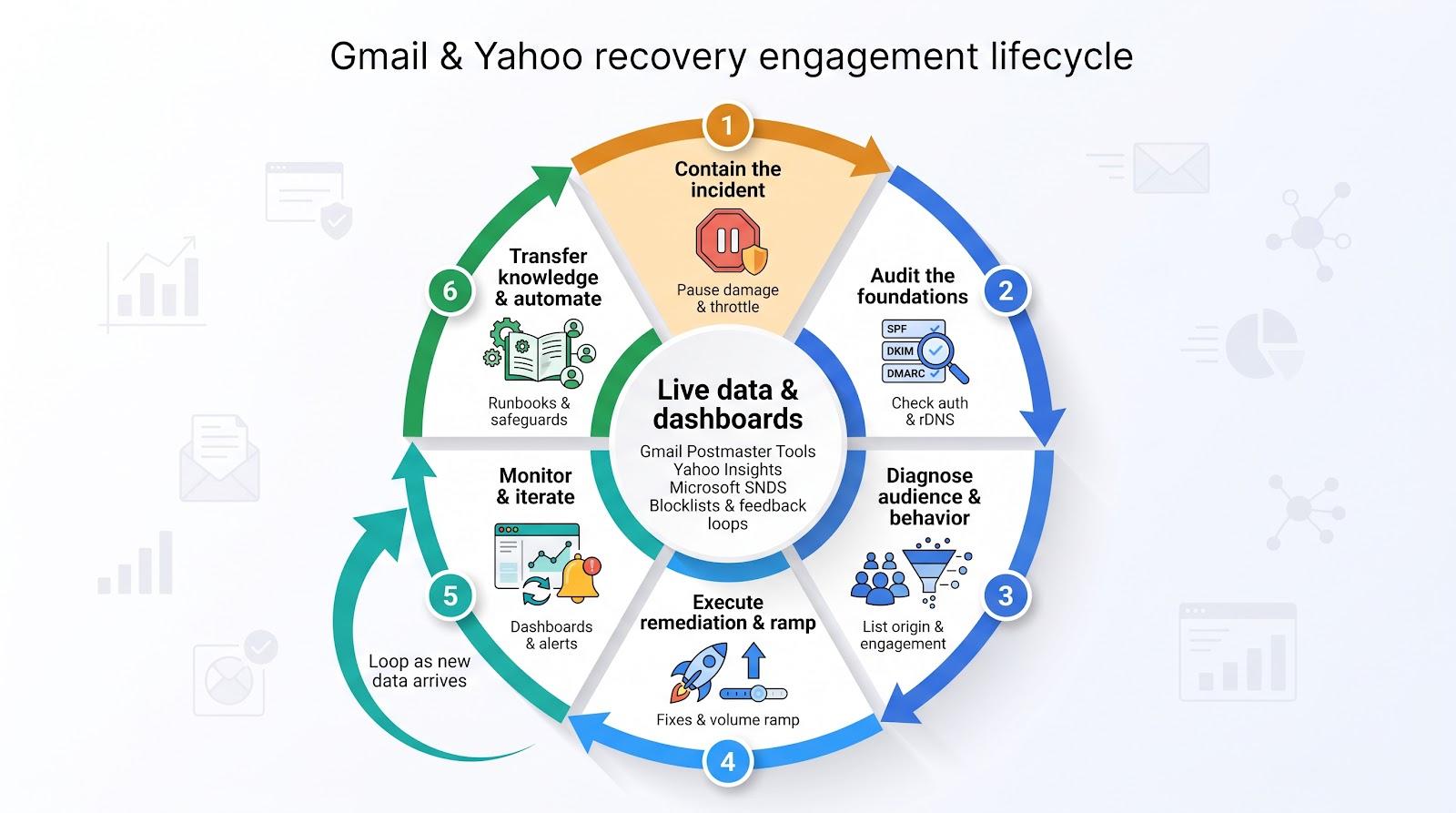
Phase 1. Contain the incident.
Slow or pause the sends causing damage: suppress chronically inactive addresses, separate marketing from transactional traffic, or throttle volume while you confirm the root cause.
Phase 2. Audit the foundations.
Check SPF, DKIM, and DMARC alignment; trace PTR and HELO mismatches; review TLS versions; and parse raw SMTP logs for 4xx deferrals or 550 hard fails. Validate one-click unsubscribe headers and list-removal speed.
Phase 3. Diagnose audience and sending behavior.
Analyze list origin, opt-in method, bounce handling, engagement decay, spam-trap exposure, and complaint outliers by segment. Layer in cadence, send time, and recent template changes.
Phase 4. Execute remediation and a controlled ramp.
Roll out fixes in small, measurable batches: DNS updates, list purges, segmentation rules, new suppression logic, and domain separation. Ramp volume gradually, favoring the most engaged recipients, and adjust daily using Gmail Postmaster Tools, Yahoo’s Complaint Feedback Loop, and Microsoft SNDS.
Phase 5. Monitor and iterate.
Track spam-rate drift, complaint spikes, block-list hits, and authentication errors in near real time. When a metric moves, tweak cadence, targeting, or content before the next campaign.
Phase 6. Transfer knowledge and automate safeguards.
Deliver runbooks, documented DNS records, suppression rules, and alert thresholds. Train marketing, CRM, and IT teams to read provider dashboards so they catch issues before revenue feels the hit.
If a proposal skips any of these phases, ask why. A missing link usually sends mail straight back to Spam.
How to choose the right deliverability consultant
Every inbox crisis feels urgent, but not every crisis needs the same kind of help. Match the root cause to each consultant’s core strength before you build a shortlist.
|
Your main issue |
First expert to call |
|---|---|
|
SPF, DKIM, or DMARC won’t align |
Infrastructure-heavy firm such as Postmastery |
|
Placement tanked after a list purchase |
List-quality specialist like Kickbox |
|
Gmail or Yahoo complaints spiked despite clean lists |
Forensic adviser such as Word to the Wise |
|
Multiple brands share one shaky MTA |
Full-service crew like InboxArmy |
|
Data is in place, but no one is watching dashboards |
Data-led partner such as Inbox Monster |
After mapping the problem, ask each candidate four decisive questions:
- Who owns implementation? A report means nothing until DNS, suppressions, and segmentation rules change in production.
- What evidence shows similar wins? Request a redacted case that matches your provider mix, volume, and industry; look for hard metrics such as Gmail spam rate or Microsoft 550 5.7.515 reductions.
- How will progress be measured week by week? Define baselines, targets, and dashboards before work starts.
- What happens after the fix? Recovery without monitoring leads to relapse. Insist on dashboard ownership, alert thresholds, and a documented playbook.
Red flags when hiring an email deliverability expert
Most consultants sound convincing, but a few play a risky game. Watch for these warning signs before they drain budget and reputation:
Guaranteed inbox placement
No consultant controls Gmail or Yahoo algorithms. Anyone promising Primary-tab placement is selling wishful thinking or tactics that backfire.
Claims of a universal whitelist
Yahoo says it has no whitelisting program at all, and Gmail’s only comparable exception was a short 2022 pilot for approved U.S. political committees, never a marketer program.
Look-alike or throw-away domains
Using cousin domains or mailbox rotation hides problems instead of fixing them. Mailbox providers treat the practice as evasion, and Gmail aggregates volume at the primary-domain level.
Artificial warm-up engagement
Bots that fake opens, clicks, or replies inflate vanity metrics, but mailbox providers detect manipulation quickly, often penalizing the sender more harshly than the original issue.
“Spam-word” obsession
Modern filters rank reputation, engagement, and authentication far above single words in a subject line. If the first suggestion you hear is “remove ‘Free,’” keep looking.
No access to raw data
Effective recovery needs SMTP logs, Postmaster spam rates, Yahoo complaint curves, and Microsoft SNDS feeds. A vendor who ignores these sources lacks the tools to solve real problems.
Junior staffing behind senior sales calls
Ask who will manage your account day to day. If résumés turn vague, you may end up training new hires at your expense.
No post-project monitoring plan
Fixes decay. Without dashboards, alerts, and documented thresholds, you’ll face the same crisis again in six months.
If a pitch feels too easy, too secret, or too focused on cosmetic metrics, trust your instincts and walk away.
How much email deliverability consulting costs
Sticker shock often stops a project before it starts, so let’s make pricing tangible. Rates seen across marketplaces, boutique quotes, and published platform tiers cluster into three bands:
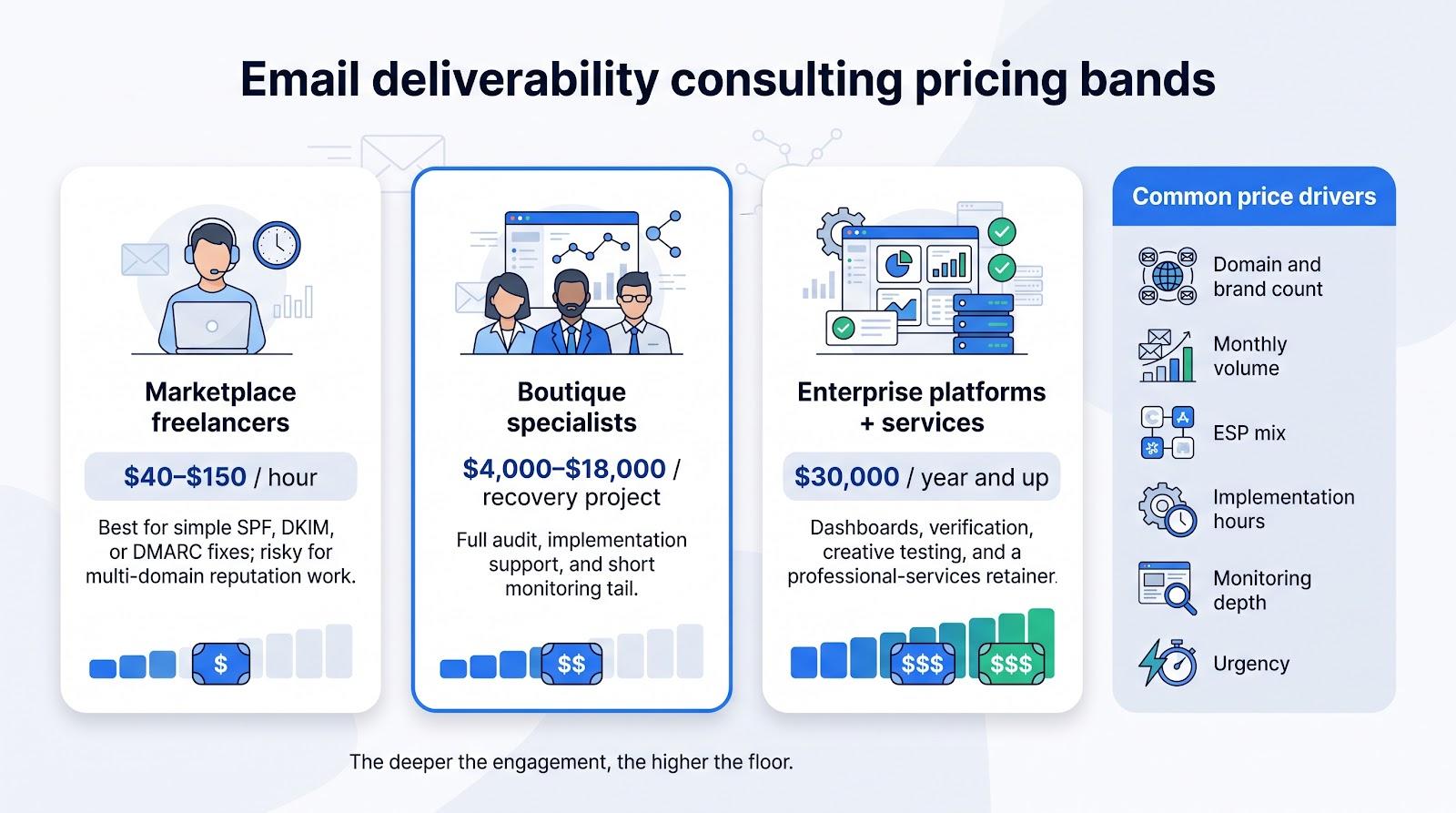
- Marketplace freelancers: $40-$150 an hour, best for simple SPF, DKIM, or DMARC fixes; risky for multi-domain reputation work.
- Boutique specialists: $4,000-$18,000 per recovery project, covers a full audit, implementation support, and short monitoring tail.
- Enterprise platforms plus services: $30,000 a year and up, bundles dashboards, verification, creative testing, and a professional-services retainer.
Published examples: MailMonitor’s bundled tiers run $1,000 to $3,000-plus a month, and Inbox Monster’s Deliverability Suite starts at $15,000 a year. Actual quotes shift with scope, but the pattern holds: the deeper the engagement, the higher the floor.
Common price drivers
- Domain and brand count. Every extra domain needs its own authentication and warm-up plan.
- Monthly volume. Sending 5 million messages a day generates far more log data than 50,000.
- ESP mix. One Mailchimp account is simpler than a hybrid of Salesforce Marketing Cloud and SendGrid.
- Implementation hours. Writing DNS records is cheap; coordinating legal, security, and development teams is not.
- Monitoring depth. Real-time dashboards with seed and panel data cost more than weekly spreadsheets.
- Urgency. A live revenue outage commands after-hours, premium rates.
Conclusion
Translate any proposal into recovered revenue. If spam placement hides ten percent of an e-commerce newsletter worth $500,000 a month, a mid-five-figure remediation pays back in weeks.
Bottom line: budget enough to solve the problem once, with data and monitoring that keep you out of trouble for good.

Vaayu is a full-time blogger and content writer with a passion for digital marketing. With years of experience in the industry, he shares practical tips, insights, and strategies to help businesses and individuals grow online. When not writing, Vaayu enjoys exploring new marketing trends and testing the latest online tools.