
Ecommerce Quiz: How to Increase Conversions by Understanding Your Customers’ Needs

The digital commerce environment has reached a pivotal moment where customer expectations for personalized experiences determine business success. Traditional product discovery methods increasingly fail to address the choice overload that confronts modern online shoppers.
Interactive eCommerce quiz technology offers a strategic solution for transforming passive browsing into meaningful engagement. These tools create structured pathways from customer uncertainty to confident purchase decisions while generating valuable zero-party data.
The gap between customer expectations and business delivery continues widening across e-commerce sectors. Companies implementing quiz-driven personalization strategies demonstrate measurably superior performance compared to those relying on conventional approaches.
Quiz-Driven Customer Understanding
Consumer behavior research reveals fundamental changes in how purchasing decisions occur across digital channels. The abundance of product options creates cognitive overload, preventing customers from making confident choices without guidance.
Interactive engagement triggers psychological principles that static content cannot replicate. When customers actively participate in eCommerce quiz experiences, they develop emotional investment in the recommendation process that significantly influences purchase behavior.
Research from Interact’s comprehensive analysis reveals that the overall conversion rate when people start a quiz is 40.1%, indicating that nearly half of engaged participants become qualified leads.
This conversion rate dramatically exceeds traditional marketing methods that struggle to achieve double-digit engagement levels.
Zero-party data collection through quiz interactions provides competitive advantages in privacy-conscious markets. Unlike third-party data sources facing increasing restrictions, customer-volunteered information builds trust while delivering actionable insights for marketing optimization.
Psychological principles driving quiz effectiveness:
- Active participation creates investment in outcomes
- Structured questioning reduces decision paralysis
- Personalized results feel more credible than generic recommendations
- Interactive experiences generate memorable brand interactions
McKinsey’s research reveals that 71% of customers expect businesses to personalize interactions, with 76% expressing frustration when companies fail to deliver tailored experiences. These expectations create both challenges and opportunities for businesses seeking sustainable competitive advantage.
The eCommerce quiz format naturally addresses personalization demands by creating guided discovery experiences. Rather than overwhelming customers with extensive product catalogs, interactive questionnaires provide structured pathways to relevant solutions.
Ecommerce Product Quiz Implementation and Optimization Techniques
Successful quiz deployment requires systematic planning that aligns customer journey objectives with measurable business outcomes. The most effective implementations balance comprehensive data collection with engaging experiences that encourage completion and subsequent action.
Designing Questions That Generate Actionable Insights
Effective question architecture begins with a clear objective definition that determines quiz structure and content strategy. Businesses must establish whether they prioritize lead generation, product recommendations, customer segmentation, or market research before developing question sequences.
Question progression should replicate natural conversation patterns, starting with broad preference exploration before narrowing to specific requirement identification. This approach maintains user engagement while constructing detailed customer profiles that enable accurate product matching.
Visual enhancement plays a critical role in quiz appeal and completion rates. Professional imagery, consistent brand elements, and interactive features create memorable experiences that differentiate brands from competitors in saturated markets.
Consumer research shows that 75% of consumers expect personalization to make navigation easier across both digital and physical shopping environments. Ecommerce quiz implementations that simplify product discovery through guided questioning directly address these expectations.
Optimal question design elements:
- Clear, conversational language that matches brand voice
- Visual options that clarify choices and maintain engagement
- Logical progression from general to specific preferences
- Response options that provide meaningful differentiation
Leveraging Ecommerce Quiz Data for Conversion Optimization
Customer intelligence gathered through quiz interactions enables sophisticated segmentation strategies that power targeted marketing campaigns across multiple channels.
Email automation, retargeting campaigns, and personalized website experiences all benefit from detailed preference data collected through structured questioning.
Real-time personalization capabilities emerge when quiz responses immediately influence content delivery, email sequences, and advertising targeting. This instant activation maximizes engagement opportunities while customer interest and attention remain elevated.
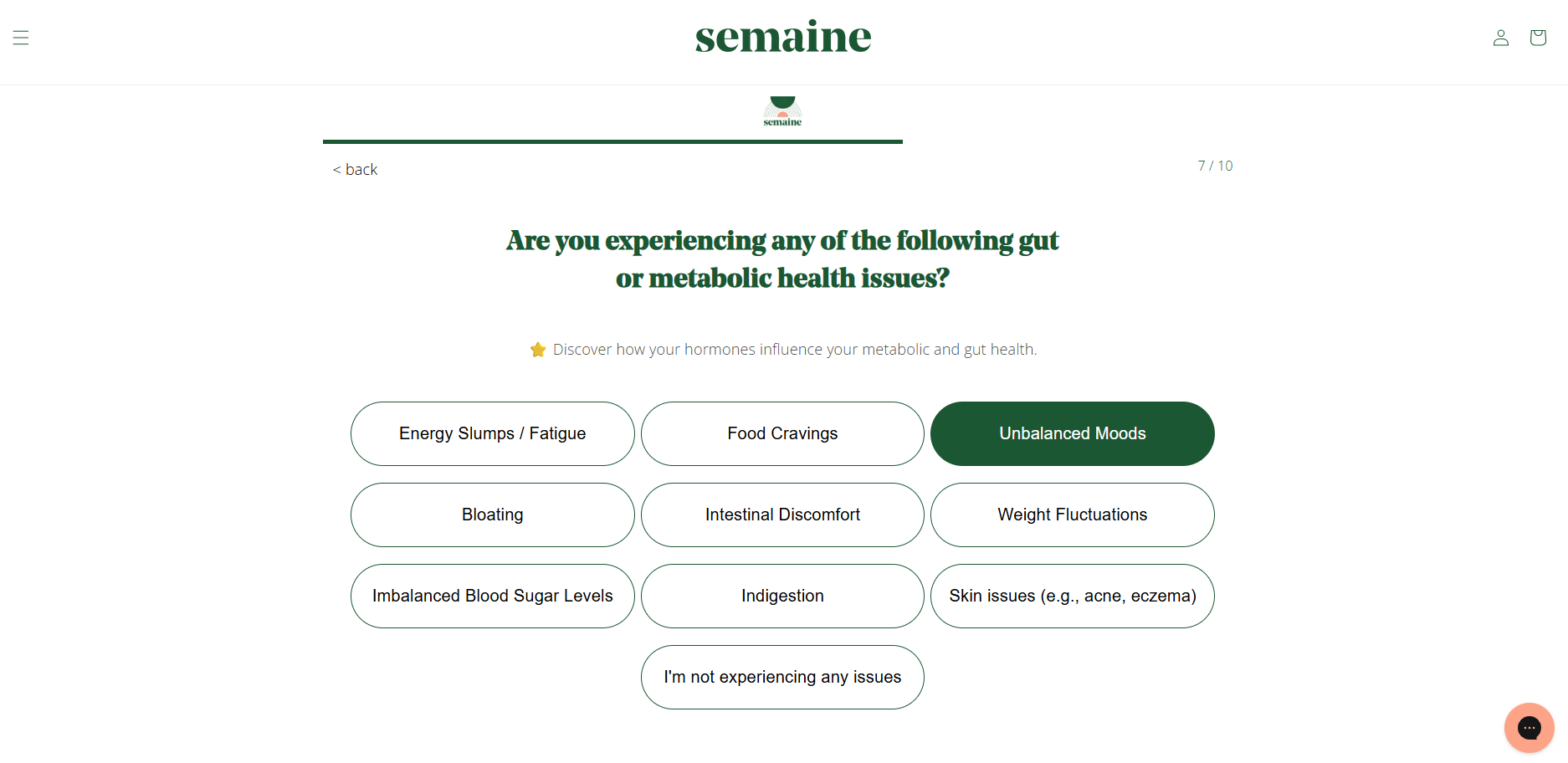
The Semaine Health hormone health quiz demonstrates exceptional performance metrics that validate quiz effectiveness: 8,675 participants, 82% completion rate, 2.5x higher conversion compared to store average, and 73% higher average order value for quiz participants.
Building Recommendation Engines That Convert
Product matching algorithms require systematic approaches that connect customer responses to relevant inventory through logical attribution systems. Successful implementations tag products with attributes corresponding to common quiz answers, creating clear pathways from preferences to specific recommendations.
Sophisticated scoring systems enable nuanced matching that considers multiple response factors simultaneously. Advanced algorithms weigh answers based on importance and relevance rather than using simple binary logic, resulting in more accurate product suggestions.
Result presentation significantly impacts conversion rates and customer satisfaction levels. Clear product displays, compelling descriptions, and obvious next-step guidance transform eCommerce quiz completion into purchase consideration and action.
WiserNotify’s analysis indicates that segmented and targeted marketing campaigns based on customer data can increase conversion rates by 50%. Quiz-driven segmentation provides the foundational data necessary for achieving these performance improvements.
Advanced Quiz Strategies for Sustained Growth
Long-term quiz program success requires continuous optimization based on performance analytics and customer feedback integration. Leading implementations treat quizzes as dynamic tools that evolve with changing customer preferences and shifting business objectives.
Performance Measurement and Analytics
Comprehensive tracking systems monitor quiz effectiveness across multiple performance dimensions, including completion rates, email capture percentages, conversion rates from recommendations, and revenue attribution. These metrics reveal optimization opportunities while demonstrating measurable return on investment.
A/B testing methodology enables systematic improvement through controlled experimentation with question formats, visual presentations, and result page designs.
Strategic modifications to wording, imagery, or recommendation structure often yield significant performance improvements over extended timeframes. Using an AI presentation maker to visualize testing data and performance trends can also help teams identify winning variations more efficiently.
Essential quiz performance metrics:
- Completion rate by traffic source and customer segment
- Email capture rate and subsequent engagement levels
- Conversion rate from quiz recommendations to purchases
- Average order value comparison between quiz and non-quiz customers
- Customer lifetime value attribution from quiz interactions
Customer feedback collection provides qualitative insights that complement quantitative performance data analysis. Understanding completion motivations and abandonment reasons informs strategic improvements that enhance user experience and business outcomes.
Contentful’s research indicates that 77% of consumers expect personalized customer experiences, making continuous optimization crucial for maintaining a competitive edge in rapidly evolving markets.
Integration with Marketing Automation Systems
Modern quiz platforms excel at connecting with existing marketing technology infrastructure to maximize data utilization and automation potential across customer touchpoints. Strategic integrations create seamless workflows that enhance both customer experience and operational efficiency.
Email marketing automation triggered by quiz completion creates immediate participant value while systematically nurturing leads toward purchase decisions.
These sequences typically include personalized product recommendations, educational content about suggested items, and time-sensitive offers designed to encourage action.
Customer relationship management integration ensures quiz insights enhance comprehensive customer profiles and support personalization strategies across all brand interactions. This unified approach creates consistent experiences that reinforce quiz-generated insights throughout the customer lifecycle.
Scaling Quiz Programs for Enterprise Growth
Successful quiz initiatives often expand beyond initial implementations to support multiple customer segments, product categories, and diverse business objectives. Scalable technical architectures enable growth without compromising performance quality or user experience standards.
Multi-channel deployment extends quiz reach across websites, social media platforms, email campaigns, and advertising networks, while maintaining a consistent brand experience. Coordinated implementation reinforces messaging while maximizing participation opportunities across customer touchpoints.
Speed Commerce data indicates that ongoing growth in personalization and mobile optimization will maintain conversion rates at 2%-4% in 2025, highlighting the continued importance of customer-centric strategies for sustainable business growth.
Team training and process documentation ensure quiz programs maintain effectiveness as organizations expand and personnel evolve. Clear guidelines for question creation, performance analysis, and optimization methodology enable sustained success across changing business conditions.
Frequently Asked Questions
What is an eCommerce quiz, and how does it work?
An eCommerce quiz is an interactive tool that asks customers questions about their preferences, needs, or problems to provide personalized product recommendations. Customers answer questions, and the quiz algorithm matches their responses to relevant products or services, creating a guided shopping experience.
What types of businesses benefit most from eCommerce product quiz implementation?
Beauty, skincare, supplements, fashion, home goods, and wellness industries typically see strong results from quiz strategies. Any business with a diverse product catalog that requires personalized guidance can benefit from quiz-driven customer interactions.
How long should a product recommendation quiz be for optimal results?
Research suggests 5-7 questions provide the optimal balance between gathering sufficient information for accurate recommendations and maintaining user engagement. Longer quizzes risk abandonment, while shorter ones may not collect enough data for meaningful personalization.
What metrics should businesses track to measure quiz success?
Key performance indicators include quiz completion rates, email capture percentages, conversion rates from recommendations, revenue attribution, average order value, and customer lifetime value. These metrics reveal optimization opportunities and demonstrate return on investment.
How do quiz apps integrate with existing marketing tools?
Modern quiz platforms integrate seamlessly with email marketing tools, CRM systems, analytics platforms, and advertising networks. These integrations enable automated follow-up sequences, comprehensive customer profiling, and multi-channel personalization strategies.

Vaayu is a full-time blogger and content writer with a passion for digital marketing. With years of experience in the industry, he shares practical tips, insights, and strategies to help businesses and individuals grow online. When not writing, Vaayu enjoys exploring new marketing trends and testing the latest online tools.