
The Ultimate SEO Audit Checklist Agencies Can Use to Deliver Fast Wins for Clients

Running an ambitious agency means balancing client expectations with tight profit margins and limited time. You know that finding quick, impactful wins is the fastest way to build trust with a new client. But digging through data manually drains your team’s resources.
A comprehensive SEO Audit is the foundation of any successful campaign. It uncovers hidden issues, provides a clear roadmap, and sets the stage for long-term growth.
When you use the right processes and an effective SEO audit checker, you can deliver flawless results, impress clients, and keep your team focused on high-level strategy instead of manual reporting.
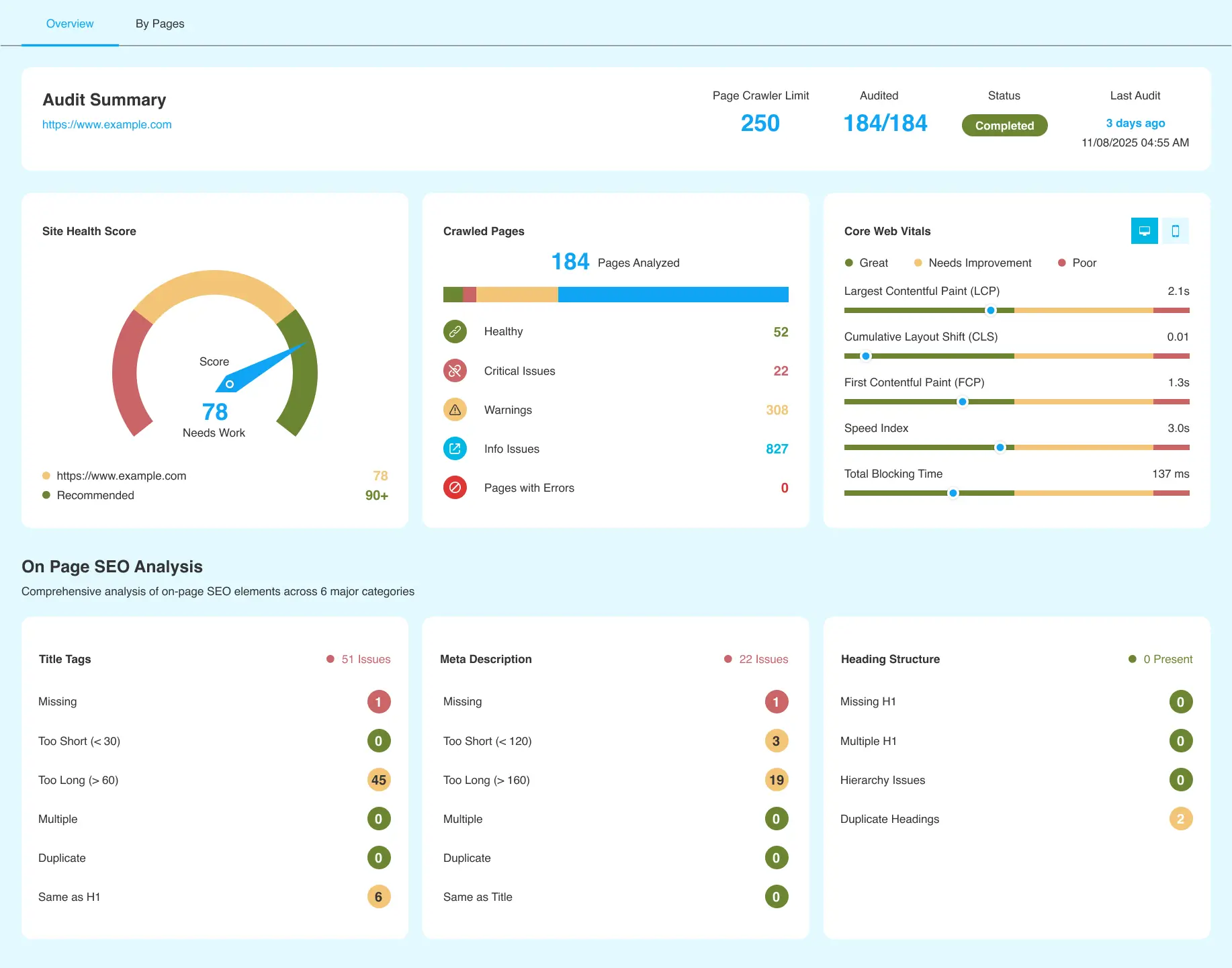
Here is the ultimate checklist and workflow you need to streamline your audits, secure fast wins, and scale your agency without adding to your payroll.
The Ultimate 4-Part SEO Audit Checklist
Breaking down your website SEO audit into clear phases makes the process seamless and ensures you never miss a critical detail. Focus on these four core areas to deliver stress-free, end-to-end results.
1. Technical SEO Audit
A technical SEO audit ensures search engines can crawl, understand, and index your client’s website without roadblocks. Fixes here often lead to the fastest traffic improvements.
- Crawlability and Indexing: Verify that the robots.txt file and XML sitemaps are properly configured. Ensure important pages are indexed and remove blocked resources.
- Site Speed and Core Web Vitals: Test page load times across desktop and mobile devices. Fast sites rank better and convert higher.
- Mobile Responsiveness: Confirm the website provides a flawless user experience on all screen sizes.
- Site Security: Check for proper SSL certificate implementation (HTTPS) and ensure there are no mixed content errors.
- Redirects and 404 Errors: Identify broken links and implement correct 301 redirects to preserve link equity and improve user experience.
2. On-Page SEO Audit
On-page elements tell search engines exactly what a page is about. Optimizing these elements is a proven way to capture targeted traffic.
- Title Tags and Meta Descriptions: Ensure every page has a unique, compelling title and description that includes primary keywords.
- Header Tag Structure: Check that H1, H2, and H3 tags logically organize the content and feature relevant terms.
- Keyword Optimization: Verify that target keywords appear naturally in the introduction, body paragraphs, and URL slugs.
- Internal Linking: Build a reliable internal linking structure to distribute authority to high-priority landing pages.
- Image Optimization: Compress heavy images and add descriptive alt text to improve accessibility and image search rankings.
3. Content Audit
Content is the engine that drives organic growth. An audit identifies what is working, what needs updating, and what you should remove.
- Content Quality and Relevance: Assess whether the content directly answers user intent and provides genuine value.
- Thin or Duplicate Content: Identify pages with very little text or content copied from elsewhere. Consolidate or rewrite these pages to avoid algorithmic penalties.
- Keyword Cannibalization: Spot instances where multiple pages on the same site compete for the same keyword. Merge them to create one authoritative resource.
- Content Gaps: Compare the client’s site against top competitors to find topics and keywords they are missing.
4. Backlink Audit
A healthy link profile builds trust with search engines. Evaluating this profile protects your client from penalties while highlighting growth opportunities.
- Link Quality and Relevance: Review the authority of referring domains. High-quality, niche-relevant links matter far more than sheer quantity.
- Toxicity Check: Identify spammy or harmful links that could trigger a manual action or algorithmic downgrade. Prepare a disavow file if necessary.
- Anchor Text Distribution: Ensure the anchor text profile looks natural, balancing branded, exact match, and generic phrases.
- Broken Backlinks: Find external links pointing to 404 pages on the client’s site and restore or redirect them.
Explaining Metrics to Clients Without the Jargon
Clients do not care about crawl budgets, canonical tags, or render-blocking JavaScript. They care about revenue, leads, and visibility. To act as a trusted partner, you must translate technical findings into business outcomes.
Instead of saying, “Your server response time is over two seconds,” say, “Your website is loading slowly, which is causing 40% of your visitors to leave before reading your services. Fixing this will help you capture more leads.”
Focus your white-label reporting on these valuable metrics:
- Organic Traffic Growth: Show them how many more potential customers are visiting the site.
- Keyword Rankings: Highlight movements for high-intent search terms that drive sales.
- Conversion Rates: Connect traffic to actual form fills, phone calls, or product purchases.
- User Engagement: Explain how long people stay on the site and how many pages they view, proving the content resonates with their target market.
When you communicate with clarity and focus on practical solutions, you reinforce your value as a reliable extension of their team.
Prioritizing Fixes for Measurable Results
Not all audit findings carry the same weight. Ambitious agency owners know how to prioritize tasks to deliver fast wins that justify their retainers.
Start by addressing critical technical errors. If a site has a noindex tag blocking the homepage, fixing it will yield immediate, massive results. Next, target “low-hanging fruit” like optimizing title tags and headers on pages that already rank on page two of search results. A few strategic tweaks can push these pages onto page one quickly.
After securing these early victories, move on to time-intensive tasks like comprehensive content rewriting and systematic link building. By phasing the work, you demonstrate progress immediately while setting a reliable foundation for long-term campaigns.
Streamlining Workflow: From Audit Error to Developer Task
Identifying website issues is only half the battle. Executing the fixes seamlessly is what separates highly profitable agencies from struggling ones.
Managing tasks through disconnected spreadsheets creates coordination gaps and slows down progress. The most efficient agencies automate this workflow.
When your SEO audit checker flags an error, like a broken internal link or a missing alt tag, you should be able to instantly assign that specific task to a developer or content writer right from your platform.
By keeping the audit data and task management in one centralized system, you maintain total accountability. Your team knows exactly what to fix, and you can track completion rates without constant follow-ups.
This end-to-end approach ensures your client campaigns stay on schedule without delays or confusion.
How Automating Audits Drives Agency Growth
Manual reporting eats your time and kills your margins. Gathering data from multiple disconnected platforms, pasting it into spreadsheets, and formatting it into a presentation can take hours per client.
Automating your SEO audit workflow changes everything. A professional, all-in-one platform handles the heavy lifting, generating comprehensive insights in minutes. This allows you to generate white-label reports that perfectly match your agency’s branding, impressing clients with your creative quality and professionalism.
When you automate these tedious workflows, you free up your team to focus on high-impact strategy. You also build a powerful asset for client retention and upselling.
Regular, automated audits show clients exactly what you have fixed and what you need to tackle next, making it simple to justify continued investment or pitch a higher retainer for additional services.
Case Study: Scaling an Agency with 50 Clients Using a White-Label Tool
Consider the real-world impact of consolidating your tool stack. A growing SEO agency managing 50 client accounts was struggling to scale. Their team spent the last week of every month manually pulling data from three different platforms to create client reports. They were losing nearly 40 hours a month just on formatting.
They decided to switch to an all-in-one SEO and Marketing agency platform with powerful SEO Tools with white-label SEO dashboard and reporting, SEO audit and rank tracker functionalities. The results were transformational:
- Saved Time and Money: By replacing three expensive tools with one unified platform, they cut software costs by 40%.
- Reduced Manual Labor: Automated reporting saved their account managers 40 hours a month, allowing them to take on more accounts without hiring additional staff.
- Pitched Higher Budgets: With professional, customized reports that clearly translated complex data into business outcomes, they looked like a much larger enterprise agency. This confidence allowed them to pitch and win higher-budget clients.
- Improved Task Management: They used the platform to automatically assign technical SEO audit fixes directly to their developers, eliminating email back-and-forth.
By embracing automation and a single source of truth, the agency achieved better margins, built better systems, and eliminated the manual tasks holding back their growth.
Take the Next Step for Your Agency
Running a successful agency requires delivering consistent, measurable results without burning out your team. A structured SEO audit is your best tool for uncovering opportunities, securing fast wins, and proving your value to clients month after month.
By utilizing a comprehensive, automated toolset, you can streamline your operations from initial crawl to developer task assignment. Stop juggling disconnected spreadsheets and start operating like the elite, growth-focused agency you are.
Implement this checklist today, automate your workflows, and watch your client retention and profit margins soar.

Vaayu is a full-time blogger and content writer with a passion for digital marketing. With years of experience in the industry, he shares practical tips, insights, and strategies to help businesses and individuals grow online. When not writing, Vaayu enjoys exploring new marketing trends and testing the latest online tools.