You are looking at an AI-generated article draft that appears to have been written by a group of robots. Although the information needed for the article is included, you can hear the lack of tone or “voice” in the article.
Now, you will attempt to create a tone/voice in the article that makes it seem as if you were the one who wrote it. This can take almost as long as starting from scratch.
As a blogger who has used AI to help generate content for your blog posts and meet your publishing deadlines, you have most likely experienced this problem before. There is no doubt that AI has been beneficial for generating ideas to overcome writer’s block and to quickly produce first drafts of articles.
However, there is a catch. AI-generated articles typically sound unnatural due to the overly smooth and perfectly balanced sentences and the complete absence of a personal touch.
This is where AI humanizers come into play. Humanizers use AI-generated content and alter it to sound more like it was written naturally, like a human, and hopefully similar to your own voice. A good humanizer is necessary for bloggers who want to stay true to themselves while increasing the amount of content on their blogs.
Blogging is a fast-paced environment. Your readers will anticipate new information on a fairly regular basis, search engines will reward consistency with higher rankings, and your competition is not going to slow down either.
AI Writing Tools were promoted as a solution to this “content generation” issue, and in many ways, they have solved it. With an AI writing tool, you can create content much faster than before.
However, there is a drawback. Most AI-generated content is easily identified by detection tools. Google’s algorithms continue to improve their ability to identify synthetic content.
Even though your content may pass through all of the detectors, most readers can tell when something does not sound quite right. A robotic tone can cause distrust, and trust is what blogging is all about.
A Humanizer bridges this gap for you. A Humanizer takes your AI-assisted drafts and puts them back into the variations, personalities, and natural flow that create authenticity in your content. You get the efficiency of AI without losing the personal touch your readers expect from your blog.
How We Selected These Tools
We did not simply develop an index of “popular” names, as every single one of these humanizers has been tested in real blog content across many different niches, such as lifestyle, technology, business, and self-improvement.
The output of each of our humanizers was then run through several major detection platforms (such as Originality.ai, Turnitin, and GPTZero) to determine which ones are most likely to be able to pass through review or detection.
In addition, we have reviewed the pricing for all of our humanizers from the perspective of a blogger. For example, while some bloggers do operate large-scale content companies, most bloggers don’t and therefore require a solution that will work for their budgetary constraints.
Finally, we have examined how easy it is to use our solutions so that you won’t have to get a technical degree to humanize your content.
The 7 Best AI Humanizers for Bloggers
Here’s what actually works.
1. Walter Writes AI – Best Overall for High-Volume Bloggers
What sets Walter Writes apart is its ability to create readable content that will be detected less than 100% of the time by using what they call “syntactic and semantic morphing,” which is another term for rewriting your content to have varied sentence structures and/or vocabulary, but still conveys the same ideas as your original content.
Walter Writes can create content in over 80 languages and also allows users to select from several different tones (academic, formal, casual, marketing) to accommodate writing for different audiences and/or experimenting with their tone.
A blogger who writes about 50 articles a week stated that their search engine rankings remained steady during the 2025 core update to Google’s algorithm, indicating the high-quality content produced. You can also read an independent user’s experience with Walter Writes here.
There is a free version of Walter Writes that allows for up to 300 words, to allow users to test the program. The starter plan costs around $12/monthly for 30,000 words, and the business plan costs $24/monthly for 70,000 words; both plans provide an adequate amount of word count for most bloggers publishing several times each month.
Users simply copy and paste their original AI-generated content into the web-based application, choose the desired tone, and then click submit. In less than 1 minute, the web application will process the content and produce revised content that is written in a more natural style without having to recreate the user’s original content.
Based on internal testing, the average human readability score of Walter Writes content was 95% or better across all standard detection benchmarks.
Walter Writes is best suited for bloggers who are looking for an affordable solution to generate high-quality content that has the highest possible bypass rate and is capable of generating enough content on a monthly basis to support a consistent publishing schedule.
2. Quillbot AI Humanizer – Best for Quick Sentence-Level Edits
Quillbot has a solid background in rewording, and this new feature enhances that capability. Quillbot’s humanizer is specifically great at reworking single lines of text or blocks of text and doing so very fast. It does not have all of the capabilities that other options do; however, it will suffice for writers/bloggers who are looking to rephrase only certain parts of their content.
In addition, the integration of Quillbot with grammar checking tools is a nice convenience to writers who may already be utilizing Quillbot for editing purposes; i.e., you can paraphrase, edit (grammar), and finish polishing your content within one application, rather than switching back and forth between applications.
However, while there are advantages to utilizing Quillbot’s humanizer, the disadvantage would be that it is more ideal for minor adjustments to content as opposed to reformatting an entire document.
Depending on the plan you select, pricing starts at approximately $20 per month, and the word limit varies. Therefore, check out the current plans they offer to see how many words you will be able to process with each plan.
This humanizer is best suited for manual content creators (bloggers) who use artificial intelligence to assist in generating content and need to rework portions of the generated content.
3. Grammarly AI Humanizer – Best for Bloggers Prioritizing Readability
Grammarly was designed with the focus on clarity and polish, and its humanizer is reflective of this approach. Although the tool may not defeat all AI detectors, it does help create clearer and easier-to-read content. If you are more concerned about creating readable content than defeating AI detection software, Grammarly is a great option.
Grammarly’s humanizer is part of their overall writing assistant; you have access to both humanization tools as well as their spell check, grammar check, and tone suggestion tools. Therefore, if you are a blogger who already utilizes Grammarly, the humanizer will be an easy addition to your writing process.
Grammarly pricing ranges from approximately $30 per month for their premium plans. Their pricing is on the higher side when compared to other stand-alone humanizers; however, you are getting the entire Grammarly suite in addition to the humanization tool.
Therefore, best for bloggers looking to enhance their overall writing quality and do not mind paying a bit more for the service.
4. Jasper Paraphrasing Tool – Best for Professional Bloggers with Existing Subscriptions
The paraphrase tool is just part of Jasper’s larger content creation toolset, and Jasper positions itself as a platform for creating a wide variety of content, including content for your business or marketing efforts. Therefore, the paraphrased output will tend to be written in an appropriate tone for writing about professional subjects.
Jasper does present pricing challenges, however. Plans begin at $49/month. This can be very expensive when you only want a humanizer, but if you are already generating content with Jasper, the addition of the paraphrasing feature provides additional benefit without requiring an additional subscription.
For use by professional writers or businesses who have already invested in Jasper’s content creation suite.
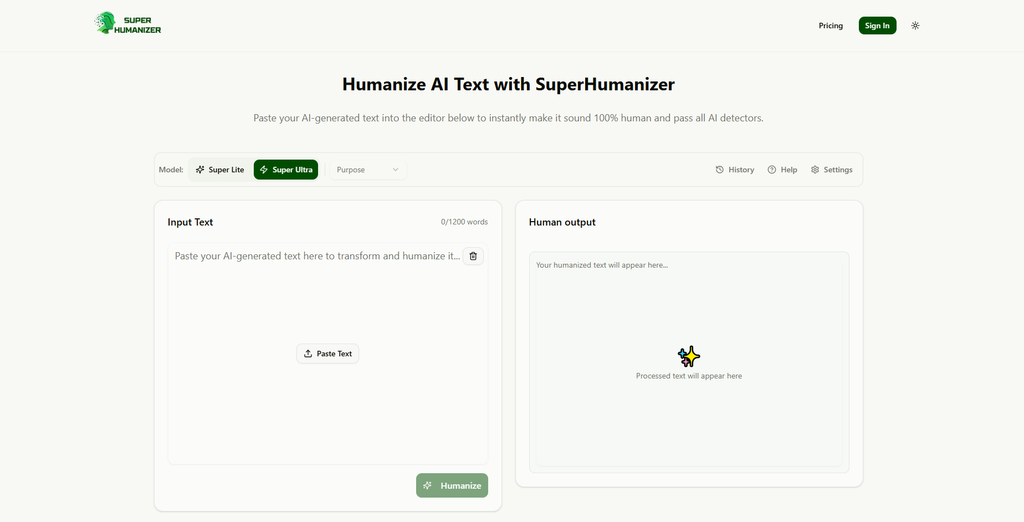
5. SuperHumanizer – Best for Creating Natural, Human-Like Blog Content
SuperHumanizer is made for bloggers, marketers, and content creators. It helps turn AI text into writing that sounds more like a real person. The meaning stays the same, but the words feel more natural.
The tool does more than swap a few words. It changes sentence structure and improves the flow. This makes blog posts and articles easier to read. The final text sounds less robotic and more human.
We found that SuperHumanizer keeps the main idea while making the content clear and smooth. It is also easy to use. Paste your text, pick a humanization mode if you want, and let the tool rewrite it. Most results are ready in just a few seconds. It is still smart to read the final version before you publish it and make sure it matches your style.
The tool has different pricing plans. Word limits and features can change, so check the latest options before you choose a plan.
Overall, SuperHumanizer is a good option for people who use AI writing tools but want content that reads well, flows better, and feels like it was written by a real person.
Quick Comparison: Features and Pricing
Tool
Starting Price
Word Capacity
Standout Feature
Walter Writes
$12/month
30,000 words
Multiple tone options and high bypass rate
SuperHumanizer
$12/month
Varies by plan
Human-like content with natural flow
Quillbot
$20/month
Varies by plan
Integrated grammar tools
6. Writesonic AI Humanizer – Best for SEO-Focused Bloggers
Writesonic portrays itself as a platform for creating SEO-friendly content. The humanizer also aligns with this focus. Writesonic has a selection of templates for use in creating blogs that will assist in maintaining a structural outline while providing a humanized version of the content.
If Search Engine Optimization (SEO) is your main priority, then Writesonic could be a viable option due to its ability to preserve keyword utilization while changing the way sentences are structured.
Writesonic allows integration with other content generation tools, so you can create, draft, and humanize all from one workspace. The cost of Writesonic can range from $16 per month for their standard plan, which makes it affordable for solo bloggers.
Recommended for bloggers who have search engine optimization as their primary goal and would like a tool that incorporates keyword placement when humanizing.
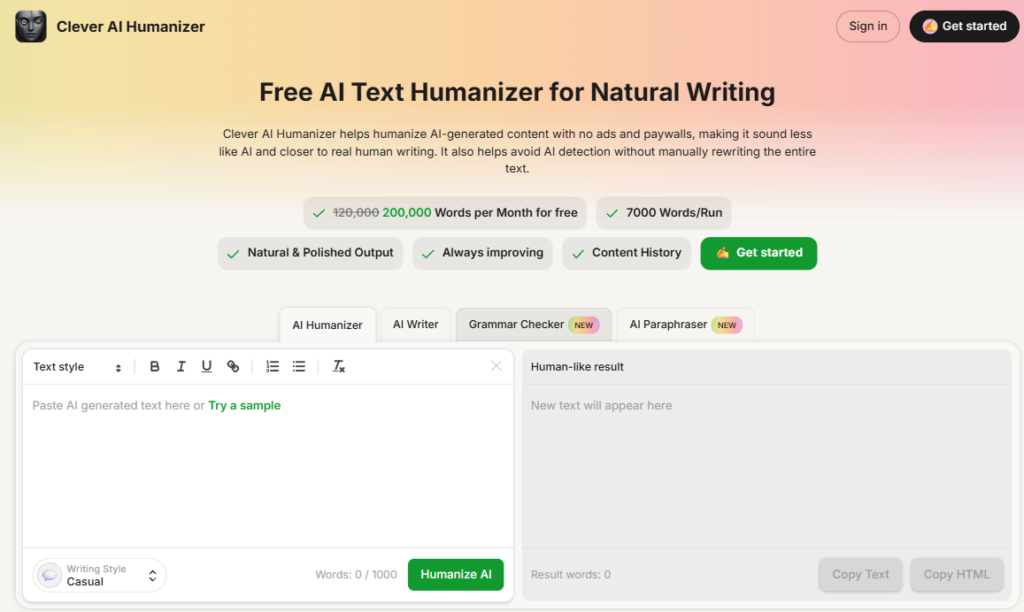
7. Clever AI Humanizer – Best for Bloggers Who Want High-Quality Humanization for Free
Clever AI Humanizer focuses on making AI-generated content sound genuinely natural without changing its meaning or introducing awkward phrasing.
Rather than relying on simple synonym swaps or intentionally adding mistakes, it identifies common AI writing patterns and refines sentence flow, tone, and readability to produce polished content that feels more authentic.
One feature that makes Clever AI Humanizer stand out is its generous free offering.
Unlike many AI humanizers that impose strict daily or monthly word limits, Clever AI Humanizer has no fixed monthly word allowance and can process up to 3,000 words per request, making it practical for bloggers who regularly work with full-length articles.
It also offers multiple humanization styles, allowing users to adapt content for blog posts, business writing, reports, or social media while preserving the original message.
Another advantage is that the platform is built around a dedicated humanization model trained on one million human-written texts, rather than relying solely on prompt-based rewriting.
This allows it to produce smoother, more natural output while maintaining context, clarity, and consistency throughout longer pieces of content.
Bloggers can also access features such as content history, making it easier to revisit previous work without starting over.
Clever AI Humanizer is completely free to use, requires no complicated setup, and delivers humanized text within seconds.
Whether you’re refining AI-assisted blog posts, improving SEO articles, or polishing marketing copy, it provides an efficient way to make AI-generated writing feel more natural and engaging.
Best for bloggers, SEO writers, freelancers, and content creators looking for a powerful free AI humanizer with long-form support, multiple writing styles, and consistently natural output.
8. ChatHuman.ai – Best for Lifestyle and Personal Bloggers
I think one of the best aspects of ChatHuman.ai is how well it can preserve your conversational tone; so it’s very useful for lifestyle, personal development, etc., types of blogs where you are more concerned about having an “authentic” voice to your readers rather than precise technical information.
It is easy to use; the cost is reasonable (approximately $15 per month); and as long as your primary concern is keeping your writing casual and conversational, like many personal bloggers prefer, then it will likely do what you want.
I don’t think this is one of the better options if you’re trying to beat the institutional AI checkers that many institutions now employ, but if your primary goal is to have a writing voice that sounds authentic and/or casual in your blogging style, then it might be a good option for you.
Best for Personal Bloggers and Lifestyle Bloggers who want a tool that is easy to use and will keep their writing tone conversational.
9. Ahrefs AI Humanizer – Best for Bloggers Already Using Ahrefs for Research
Ahrefs focuses primarily on SEO data research and analysis versus content creation. The humanizer is an additional tool to their overall suite of tools, which includes keyword research, backlinks, and content planning. Since you are likely already using Ahrefs ($99/month), the humanizer will be a free addition to your overall Ahrefs subscription.
Ahrefs is best suited for creating SEO driven content due to its pricing; however, if all you want is a humanizing tool, it may be overkill since there are less expensive options available for just a humanizer.
Best for those bloggers who currently use Ahrefs for their overall keyword research and content strategy needs.
10. GPTHumanizer AI – Best Free Option for Quick Blog Draft Refinement
GPTHumanizer AI is a practical option for bloggers who want to turn AI-assisted drafts into more natural, readable content without adding another complicated tool to their workflow. With GPT Humanizer, users can improve sentence flow, reduce repetitive phrasing, and make AI-generated blog content sound smoother while keeping the original meaning intact.
One of its main advantages is accessibility. Bloggers can use the free Lite model with no sign-up required, making it easy to test and refine sections of a draft before final editing. This makes GPTHumanizer AI especially useful for occasional bloggers, solo creators, and small website owners who want a low-friction way to improve AI-assisted writing before publishing.
Best for bloggers who want a free, simple AI humanizer for improving blog drafts before final editing and publishing.
After: Best for Personal Bloggers and Lifestyle Bloggers who want a tool that is easy to use and will keep their writing tone conversational.
Quick Comparison: Features and Pricing
Tool
Starting Price
Word Capacity
Standout Feature
Walter Writes
$12/month
30,000 words
Multiple tone options and high bypass rate
Quillbot
$20/month
Varies by plan
Integrated grammar tools
Grammarly
$30/month
Varies by plan
Focus on clarity and readability
Jasper
$49/month
Varies by plan
Full content creation suite
Writesonic
$16/month
Varies by plan
SEO-optimized templates
Ahrefs
$99/month
Varies by plan
Part of a comprehensive SEO toolkit
ChatHuman.ai
$15/month
Varies by plan
Conversational tone preservation
What to Look for When Choosing a Humanizer
Think about what you want from your Niche. The same Tool that would be an amazing resource for Tech Blogging may take away the Personality from Lifestyle Content. So look for Humanizers that allow you to Control Tone or Writing Style so you can write in Your Voice.
Think About How Often You Post. If you are posting once a Week, a Lower-Tier Plan (10,000 to 30,000 Monthly Words) may be enough. But Daily Bloggers or those who have Multiple Sites will need a Higher Capacity Plan or an unlimited plan.
Run a Few of Your Typical Posts Through the Humanizer to Test Quality of Output. Most Platforms Offer Free Trials or Money-Back Guarantees. See if the Results Sound like You. Generic, Lifeless Output Defeats Purpose.
Look at how the Tool Integrates into Your Workflow. Do you need API Access for Automation? Does it integrate with your Content Management System? Friction Points Add Up When You Process Content on a Regular Basis.
Red Flags to Watch For
Be aware of humanizers that create all of your writing to sound the same. The voice of your blog is what makes you unique, and a humanizer that makes all of your writing generic corporate speak is not going to help your uniqueness.
Skip humanizers that will not allow you to try before you buy. If a platform does not provide at least a small amount of its service (free tier) or trial period, then that is a good indicator that the company is not confident in the product.
Be wary of humanizers that do not truly circumvent detection. Some tools simply perform some form of simple rewriting and call that “humanizing.” Use the output from the humanizer with a free detector such as Originality.ai or GPTZero to determine how well the humanizer works before paying money for a subscription.
Steer clear of humanizers that have questionable pricing practices. If the refund policy is hidden or very limiting, or there are many complaints from customers regarding billing issues, then look for another option.
Frequently Asked Questions
Do AI humanizers work for all blogging niches?
Most humanizers handle general content well, but specialized niches (technical, medical, legal) can be trickier. Tools with tone controls tend to perform better across different subjects. Test your specific niche before subscribing.
Can humanizers help with SEO?
Indirectly, yes. If humanized content avoids detection and maintains readability, it’s more likely to perform well in search. But humanizers don’t optimize for keywords. That’s still on you.
Will using a humanizer change my writing voice?
It can if you’re not careful. The best approach is to humanize AI drafts, but then review and adjust the output to match your style. Think of the humanizer as a first pass, not a final product.
Are humanizers worth it for occasional bloggers?
If you’re only publishing once or twice a month, you might get by with free tiers or lower-cost options. But even occasional bloggers benefit from having a reliable tool ready when they need it.
How do I know if a humanizer is working?
Run the output through free AI detectors. If it consistently scores as human-written (80% or higher human probability), the tool is doing its job. Also, trust your own reading. If the text feels natural, it probably is.
Can I use humanizers with content I write myself?
Absolutely. Some bloggers use humanizers to add variety to their own writing, especially if they tend to fall into repetitive patterns. Just be aware that over-humanizing can make your content feel less like you, not more.
Vaayu is a full-time blogger and content writer with a passion for digital marketing. With years of experience in the industry, he shares practical tips, insights, and strategies to help businesses and individuals grow online. When not writing, Vaayu enjoys exploring new marketing trends and testing the latest online tools.